> ## Documentation Index
> Fetch the complete documentation index at: https://kb.hosting.com/llms.txt
> Use this file to discover all available pages before exploring further.
# Adding spam and delete button in WordPress comment section using PHP
> Discover how to add delete and spam buttons to WordPress comments using PHP.
Having a spam and delete button in the [WordPress](https://hosting.com/hosting/platforms/wordpress-hosting/managed-wordpress-hosting/) blog post comment section allows administrators to manage unwanted comments with a single click. This article shows how to add the spam and delete button to the [WordPress](https://hosting.com/hosting/platforms/wordpress-hosting/managed-wordpress-hosting/) blog comment area using PHP code.
## Adding a spam and delete button in the WordPress blog comment section.
**Important**
Always perform a backup before you make any changes to the theme files. It will be easier for you to revert your site to its last good known state if you break any codes. Alternatively you could also create a child theme. Read this link on how to create a child theme: [https://www.hosting.com/blog/wordpress-child-theme/](https://www.hosting.com/blog/wordpress-child-theme/)
Follow the steps below to edit your Theme setting file to add spam and delete button in the comment section.
1. Log in to your WordPress site with an administrator account.
2. On the **Dashboard** in the left sidebar, click **Appearance**, and then click **Theme Editor:** \*\*\*\*
3. On the **Theme Editor**, select the **Theme** you want to edit from the dropdown:\
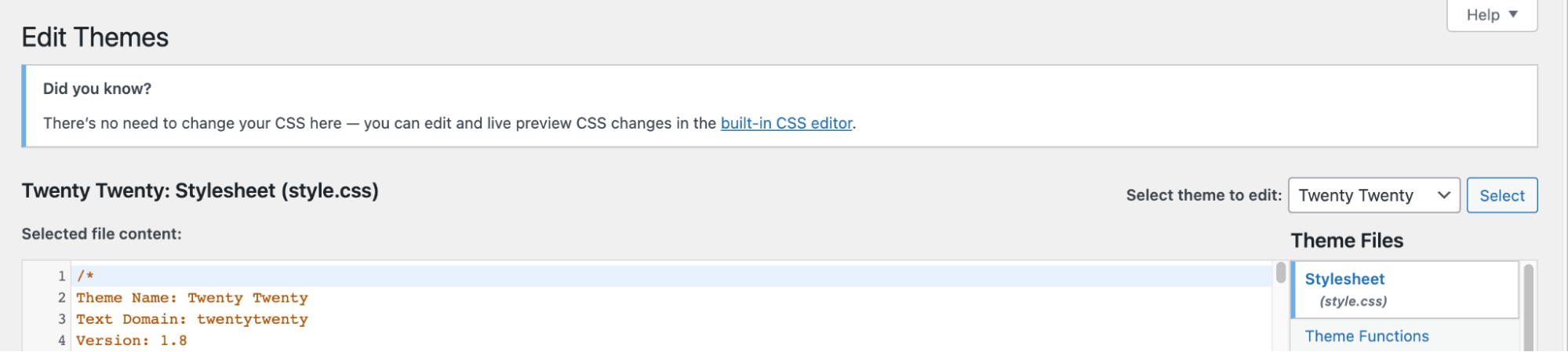
4. The files for this selected theme is listed on the right column under **Theme Files**. Click on the file named "**functions.php**":
***
5. Insert the following code to the end of functions.php file:
```javascript theme={null}
function spam_delete_comment_link($id) {
global $comment, $post;
if ( $post->post_type == 'page' ) {
if (!current_user_can( 'edit_page', $post->ID ) )
return;
} else {
if (!current_user_can( 'edit_post', $post->ID ) )
return;
}
$id = $comment->comment_ID;
if ( null === $link )
$link = __('Edit');
$link = '';
$link = $link. ' | delspam';
$link = $before. $link. $after;
return $link;
}
add_filter('edit_comment_link', 'spam_delete_comment_link');
```
6. The delete and spam link is added to the comments section.
Before:\

After:
***
7. Click on the del or spam to delete or mark the comment as spam.
## Related articles
* [Disable URL in comments from WordPress](/docs/disable-url-in-comments-from-wordpress)
* [Duplicating pages and posts in WordPress](/docs/duplicating-a-page-in-wordpress)