.jpg?fit=max&auto=format&n=E2LlsT5gBITvo732&q=85&s=ec11e1673894bdf46663a5d73602eb87)
- Make sure you have already created at least one e-mail account for your domain. If you have not done this, please see this article to learn how to create an e-mail account using cPanel.
- Log in to the Gmail account.
- Click the Gmail settings icon, and then click See All Settings:\
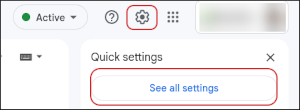
📘 Note The user interface displayed in these images may differ slightly from the version you have installed.
- Click the Accounts and Import tab:\

- On the Accounts and Import tab, in the Check mail from other accounts section, click Add a mail account:\

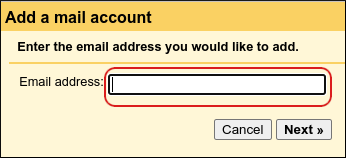
- In the Email address text box, type the hosting.com e-mail address that you want to access from Gmail (for example,[email protected] ), and then click Next:\
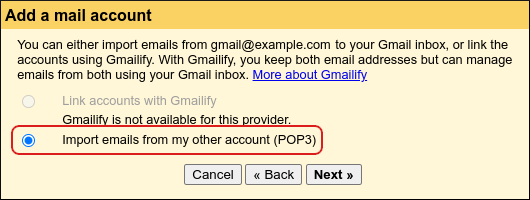
- Click Import emails from my other account (POP3), and then click Next:\
- In the Username text box, type the full e-mail address of the hosting.com account (for example, [email protected] ):\
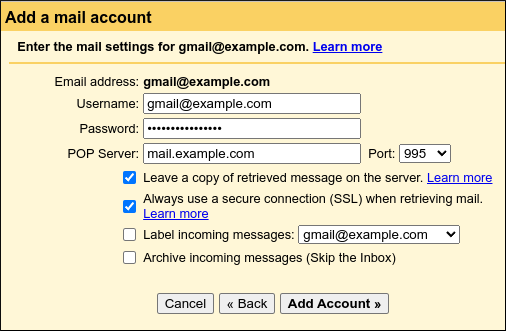
- In the Password text box, type the password for the hosting.com account.
- In the POP Server text box, type mail.example.com, where example.com represents your domain name.
- In the Port list box, select 995.
- If you want to keep copies of messages on the hosting.com server, select the Leave a copy of retrieved message on the server check box.
📘 Note If you do not select this option, Gmail will download messages and automatically remove them from the hosting.com account.
- Select the Always use a secure connection (SSL) when retrieving mail check box.
- If you want to apply a label to messages, select the Label incoming messages check box and select a label.
- If you want to automatically archive new messages, select the Archive incoming messages (Skip the Inbox) check box.
- Click Add Account. You should receive a Your mail account has been added message. If you do not receive this message, verify the information you provided in steps 6 to 11, and then try again.
- You can now retrieve messages from the hosting.com account.
- If you want to be able to send messages for the account from Gmail, click Yes and go to the next step.
- If you do not want to send messages for the account from Gmail, click No, click Finish, and then you are done.
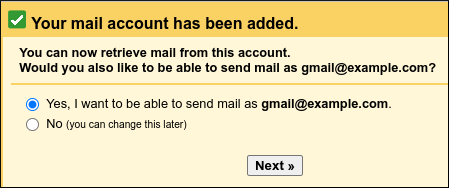
- If you selected Yes in the previous step, you must configure the outgoing mail server settings. Click Next.
- In the Add another email address you own dialog box, in the Name text box, type the name you want to appear on messages that you send from the account:\
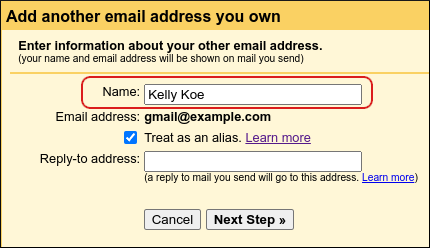
- If you want to treat the account as an alias, select the Treat as an alias check box.
👍 Tip For detailed information about what this option does, please see https://support.google.com/a/answer/1710338.
- To specify a different reply-to address, type it in the Reply-to address text box.
- Click Next Step.
- In the SMTP Server text box, type mail.example.com, where example.com represents your domain name:\
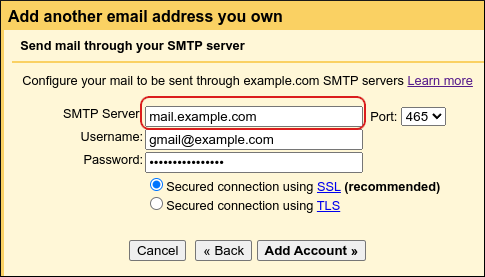
- In the Port list box, select 465.
- In the Username text box, type the full e-mail address of the hosting.com account (for example, [email protected] ).
- In the Password text box, type the password for the hosting.com account.
- Select the Secured connection using SSL option.
- Click Add Account. You should receive a confirmation message:\
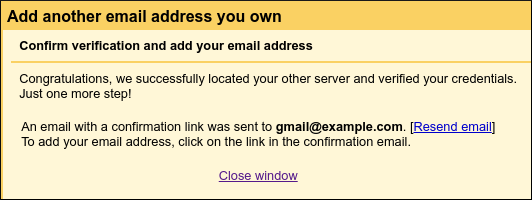
- Check the inbox of the hosting.com account (for example, [email protected] ). There should be a message from Gmail that resembles the following:\
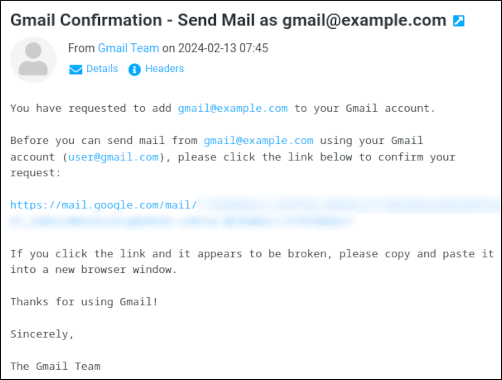
- In your web browser, go to the link shown in the message. The following message appears:\
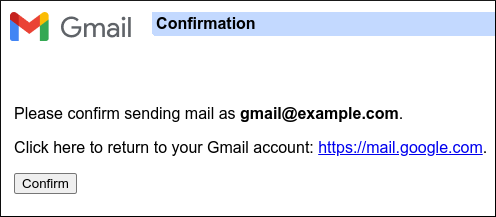
- Click Confirm. The following confirmation message appears:\
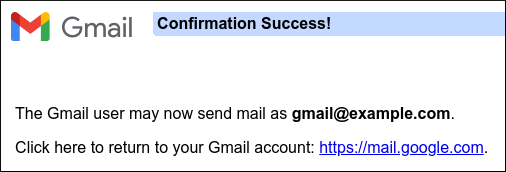
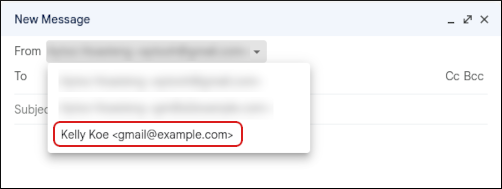
- You are now ready to send email for your hosting.com account through Gmail. To do this, when you compose a message select the correct identity in the From list box:\
Email client setup
Setting up Gmail to access your hosting.com e-mail account
Set up your hosting.com email in Gmail with our step-by-step guide.
This article demonstrates how to set up Gmail to access a hosting.com e-mail account. With Gmail access, you can view and manage both incoming and outgoing messages for your hosting.com account from the Gmail interface.
To set up Gmail to access a hosting.com e-mail account, follow these steps:
Was this page helpful?